Introduction
At the crossroads of global communication and cultural richness, a question arises that captures the essence of language learning: How many Chinese characters are there? This question not only reflects the vastness of the Chinese language, but also invites us to explore a writing system that is both art and language. Mandarin Chinese, with its millennial history and contemporary relevance, offers a universe of knowledge and connection with one of the oldest civilizations in the world.
To discover the quantity of Hanzi (汉字) is to embark on an intellectual adventure that promises to unveil secrets of human communication and open doors to new opportunities. We invite you to continue reading and immerse yourself in the fascinating world of Chinese characters, where each stroke tells a story. And of course, the key question is: how many Chinese characters are there? This figure is a window into tradition and innovation.
How many Chinese characters are there? History of Characters

Chinese characters, or Hanzi (汉字), are much more than mere linguistic symbols; they are the legacy of a civilization that has embodied its wisdom and its vision of the world in every stroke. These characters have been the backbone of communication and knowledge preservation in China for more than three millennia, becoming one of the oldest writing systems still in use today.
The history of the Hanzi is a reflection of the history of China itself, intertwined with every dynasty, every revolution, and every era. From oracle inscriptions on bones and turtle shells to sophisticated printed characters, the Hanzi have been witnesses and storytellers of a nation's evolution.
Origins of Chinese Characters (汉字 Hanzi)
The origins of Chinese characters can be traced back to ancient China, where the first forms of writing appeared on artifacts such as the Jiahu, with markings dating back to 6600 B.C. However, it was during the Shang Dynasty (1600-1046 BCE) that the Hanzi began to take shape, with inscriptions on oracle bones that served for divination and communication with the gods.
These early characters were pictograms: direct visual representations of objects and concepts. Over time, they became more abstract and stylized, evolving into ideograms that represented more complex ideas through the combination of various pictograms.
For example (see image) let's analyze 4 characters:
- Water (水, shuǐ): The original character for "water" resembled the ripples of water. Over time, this pictogram was simplified to three strokes representing the waves of water, arriving at the modern form "水" that we know today.
- Mountain (山, shān): The character for "mountain" began as a pictorial representation of three peaks. Over the centuries, it was stylized to three lines symbolizing the tops of a mountain, evolving into the character "山" we use today.
- Sun (日, rì): Initially, the character for "sun" was a circle with a dot in the center, representing the sun. This design was transformed into a rectangle with a line in the middle, which is the character "日" meaning "sun" in modern writing.
- Moon (月, yuè): The ancient character for "moon" resembled the crescent shape of the moon. Over time, it became two curves facing each other, which were then simplified to the character "月", which represents the "moon" in contemporary Chinese.
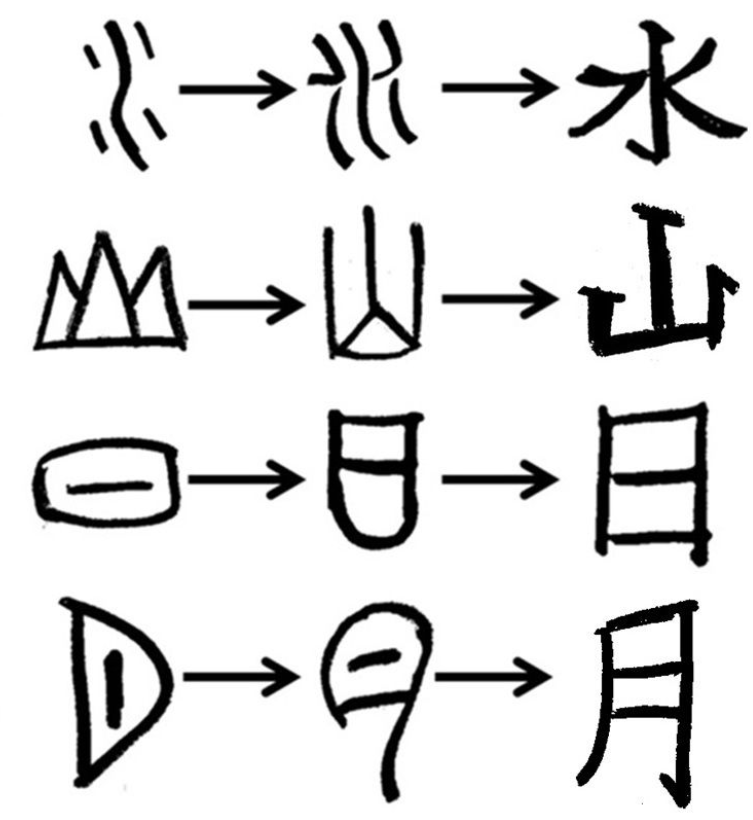
Not only are these characters fundamental in the Chinese language, but they are also a testament to how writing can evolve visually while maintaining its connection to the original images of nature.
The development of the Hanzi was an organic process, influenced by the communicative and administrative needs of a society in constant change. With the expansion of the Chinese empire, the standardization of writing became essential, culminating in the creation of the Shuowen Jiezi, the first dictionary of Chinese characters, in the second century. This effort to catalog how many Chinese characters there are reflects the richness and diversity of the language throughout history.
Historical evolution and its impact on culture
The evolution of the Hanzi did not stop with dictionaries and standardization. The invention of paper and printing during the Tang Dynasty (618-907) and Song (960-1279) respectively, revolutionized the spread of Chinese characters, allowing knowledge and literature to reach a wider audience than ever before.
During the Ming Dynasty (1368-1644), the Hanzi underwent another significant transformation with the emergence of movable typography, which made it even easier to produce written texts. This period also saw the flourishing of classical Chinese literature, with masterpieces that have endured to this day. Also, it is interesting to consider how many Chinese characters there are in total, as their number is impressive and their influence on Asian culture is undeniable.
The impact of the Hanzi on Chinese culture is incalculable. They have not only served as a means of communication, but also as an art form, with calligraphy being one of the most respected artistic expressions in China. In addition, Chinese characters have influenced other writing systems in Asia, such as Japanese and Korean, leaving an indelible mark on the continent's cultural history.
Number of Chinese characters

How many Chinese characters are there? The vastness of the Chinese language is reflected in the impressive number of characters that compose it. Although the exact number can be difficult to determine due to historical and regional variations, Chinese dictionaries provide some official figures. For example, the 2004 Chinese Character Variant Dictionary of Taiwan's Ministry of Education recorded 106,230 characters. However, in practice, a much smaller set is used in everyday life.
Official number of characters according to the Chinese dictionary
The Chinese government, in its effort to promote literacy and education, has identified a set of 3,500 characters essential to modern Chinese. Chinese students are expected to learn at least these characters, although many end their education knowing between 5,000 and 6,000. For those looking to master the language at an advanced level, such as in the HSK exam, knowledge of 2,663 characters is required. These figures are a testament to the richness and complexity of Chinese as a language.
Difference Between Simplified and Traditional Characters
The difference between simplified and traditional Chinese characters is a matter of strokes and complexity. Simplified characters, officially introduced in the mid-20th century, reduce the number of strokes required to write a character and, in some cases, combine several traditional characters into one. While traditional characters have been used since the end of the Han period, simplified characters are a more recent adaptation that seeks to facilitate learning and writing, thus reflecting the continuous evolution of the language and contributing to the total number of how many Chinese characters are in use today.
Learning Chinese Characters

Learning Chinese characters is a fascinating journey in which each step forward opens new doors to understanding and communication. For those embarking on this path, an essential question resonates strongly: How many Chinese characters do I need to learn to make my Chinese fluent? This is a vital issue, as the number of characters one masters can be an indicator of the level of fluency in the language. Knowing this number not only helps you set clear learning goals, but it also allows you to measure progress throughout your language journey.
How many Chinese characters do you have to learn to be fluent?
To reach a basic level of fluency in Chinese, familiarizing yourself with 2,000 to 3,000 characters is a good goal. Knowing the 1,000 most used characters, a coverage rate of 92% can be achieved in modern texts, while with 2,500 characters, the coverage increases to 98%. For those who want to deepen their knowledge of the language and read without major difficulties, learning up to 3,500 characters provides an understanding of 99.5% of written materials.
Methods and techniques for memorizing and practicing Hanzi
The process of memorizing Hanzi can be overwhelming, but there are methods and techniques that make retention and understanding easier:
- Character Decomposition: Learn radicals and how they combine to form complete characters.
- Mnemonics: Using stories or mental images to associate the strokes of a character with its meaning and pronunciation.
- Spaced Repetition: Practice characters regularly with progressively increasing time intervals.
- Handwriting: Writing characters by hand to improve memorization and understanding of their structure.
- Applications and Software: Use digital tools designed for Hanzi learning, such as Hanyu App, Anki or Skritter.
Implementing these techniques in your daily study will help you build a solid foundation in the Chinese language and move toward fluency confidently and effectively.
Student Tools & Resources

Learning Mandarin Chinese has been transformed with technology, offering a variety of digital tools that facilitate the acquisition of new knowledge. Here are some of the best options available for students of all levels.
Recommended apps and software for character learning
- Hanyu App: Specially designed for Hanyu Chinese School students, but open to everyone, this app offers a personalized learning experience, with interactive exercises and a focus on effective character memorization, adding tools such as podcast, videos, and more.
- Skritter: This app allows you to practice writing Chinese characters and provides you with instant feedback on your calligraphy.
- Drops: Turn learning new vocabularies into a game, ideal for quick and entertaining study sessions.
These apps are powerful tools that can complement your studies and help you advance more quickly in language proficiency.
Useful books and teaching materials
- Hanyu Chinese School Online Campus: Access a wide range of online teaching materials, including free podcasts, that will allow you to improve your understanding and use of Chinese characters.
- 'Basic Chinese Grammar': An essential resource for understanding language structure and how sentences are formed.
- 'Chinese Mandarin Conversation Guide': This book is perfect for students looking to improve their ability to communicate in everyday situations.
With these resources, both digital and printed, students have everything they need to deepen their study of Mandarin Chinese and enrich their learning experience.
Conclusion
We've navigated through the history, structure, and learning of Mandarin Chinese, one of the world's most fascinating languages. From the ancestral origins of the Hanzi to the modern digital tools that make it easy to study, the Chinese language is presented as a vast ocean of knowledge and culture. The number of Chinese characters there are reflects the depth and breadth of the language.
Whether you're ready to embark on this journey of discovery or if you want to continue expanding your language horizons, Hanyu Chinese School school is here to guide you. With courses designed for every level of learning and personalized coaching, we'll help you reach your goals and enjoy every step of the way.
For more information about our free Chinese trial class, our Chinese course or different online resources, do not hesitate to contact us. We are committed to your success and look forward to being part of your Chinese learning adventure.
Start exploring Chinese with our video. It's the perfect time to delve into this language full of history and meaning.
Are you more of a podcaster? We leave you one of our many podcasts to learn Chinese.
Now that you've reached the end of our article, we'd like to invite you to engage in a deeper conversation. Consider these questions and share your answers in the comment box:
- Which Chinese character did you find most intriguing or beautiful, and why?
- How do you think learning Chinese characters can influence your appreciation of Chinese literature and art?
- Are there any particular aspects of the Chinese language that you would like to explore more in future articles?
Your feedback is important to us and to the Hanyu Chinese School learning community. We look forward to your feedback and are excited to read about your experiences and thoughts!
Traditional Chinese medicine (TCM) is an ancient art that, as many Chinese people explain, uses various techniques to restore balance in the energy that flows through the body, mind and spirit. One of the most important modalities of TCM is herbal therapy, which uses plants with healing properties to treat and prevent disease.
Chinese plants offer a wide range of health and wellness benefits, from relieving symptoms to improving immune function to protecting the brain and heart. In this article, we present 5 Chinese plants that you may not have known about and that can improve your quality of life.
Chinese plants: Astragalus (黄芪 huáng qí)

Astragalus is a popular plant that is believed to have anti-aging and life-prolonging effects. Its main components are flavonoids, saponins and polysaccharides, which give it antioxidant and anti-inflammatory properties. Some of the benefits of astragalus are:
- It strengthens the immune system and helps fight infections.
- It regulates blood sugar and prevents diabetes.
- It protects the liver and kidney from toxins and damage.
- It improves blood circulation and prevents hypertension and cardiovascular diseases.
- It stimulates brain activity and prevents cognitive decline and dementia.
Astragalus can be consumed as a supplement, powder, extract, or tea. The suggested dose depends on the form of consumption and the therapeutic objective.
Chinese plants: Cinnamon (肉桂 ròu guì)

Cinnamon is a spice widely used in cooking, but it also has great medicinal value. Cinnamon contains compounds such as cinnamaldehyde, which give it antibacterial, antifungal and antiviral properties. In addition, cinnamon can help:
- Regulate blood sugar and improve insulin sensitivity.
- Lower cholesterol and triglycerides and prevent atherosclerosis.
- Relieve PMS symptoms and menstrual cramps.
- Fight inflammation and joint pain.
- Stimulate metabolism and promote weight loss.
Cinnamon can be consumed as a spice, capsule, essential oil, or tea. The suggested dosage varies depending on the form of consumption and the condition to be treated.
Chinese plants: Ginkgo (银杏 yín xìng)

Ginkgo biloba is one of the oldest plants in the world and is considered a symbol of longevity. Ginkgo biloba contains flavonoids and terpenoids, which are potent antioxidants that protect cells from oxidative stress. The benefits of ginkgo biloba are:
- It improves memory and concentration and prevents Alzheimer's and Parkinson's.
- It increases blood flow to the brain and the rest of the body and prevents strokes and heart attacks.
- It relieves symptoms of depression and anxiety and improves mood.
- Fights vertigo, tinnitus and hearing loss.
- It improves sexual function and treats erectile dysfunction and premature ejaculation.
Ginkgo biloba can be consumed as a supplement, extract, or tea. The suggested dose depends on the form of consumption and the therapeutic objective.
Chinese plants: Ginger (生姜 shēng jiāng)

Ginger is a root with a spicy and aromatic flavor that is used in both gastronomy and medicine. Ginger contains gingerol, a compound that gives it anti-inflammatory, analgesic, and antipyretic properties. Some of the benefits of ginger are:
- It relieves nausea, vomiting, and dizziness, especially during pregnancy and travel.
- It facilitates digestion and prevents gastritis, ulcers and reflux.
- It boosts the immune system and helps fight cold, flu, and cough.
- It reduces muscle and joint pain and helps recover from injuries and sprains.
- Increases libido and improves fertility.
Ginger can be consumed as a fresh root, powder, capsule, essential oil, or tea. The suggested dosage varies depending on the form of consumption and the condition to be treated.
Chinese plants: Ginseng (人参 rén shēn)

Ginseng is one of the most well-known and valued plants in Chinese medicine. Ginseng contains ginsenosides, which are compounds that give it adaptogenic properties, that is, they help the body adapt to stress and restore balance. The benefits of ginseng are:
- It increases energy and physical and mental endurance and fights fatigue and exhaustion.
- It improves cognitive performance and learning capacity and prevents mental deterioration.
- It strengthens the immune system and prevents infections and chronic diseases.
- It regulates blood sugar levels and prevents diabetes and its complications.
- It improves sexual function and treats erectile dysfunction and premature ejaculation.
Ginseng can be consumed as a root, powder, extract, capsule, or tea. The suggested dosage depends on the form of consumption and the type of ginseng (red, white, or American).
Conclusion
In conclusion, Chinese plants represent a gateway to a healthier and more balanced lifestyle. However, the key to its effective and safe use is professional guidance. If you also want to immerse yourself in the rich Chinese culture and master its language, Hanyu Chinese School is your perfect ally. With a team of experts and an innovative teaching method, learning Chinese has never been so accessible and exciting.
Do you like learning with videos? Don't miss our collection of videos on our YouTube channel. Check one out below
Are you more of a podcaster? Here is one:
We invite you to visit our website and discover how Hanyu Chinese School can enrich your life with knowledge of the Chinese language and ancient culture. Immerse yourself in the experience, take advantage of our cutting-edge educational resources, and join our community of satisfied students. And if you want to learn other languages and get to know other cultures, we invite you to visit Trainlang, a unique and different place for online learning. Your journey to discovery begins now!
Chinatown Madrid is a city that offers a great diversity of options for tourism, culture and leisure. Chinatown Madrid is located in the district of Usera, south of the capital. It is an area that is home to the largest concentration of the Chinese community in Spain, and has become a place of reference to learn about the gastronomy, history and life of this Asian country.
If you want to discover why Madrid's Chinatown is the new trendy destination, we give you 7 reasons to visit it.
1. Taste authentic Chinese food in Chinatown Madrid

One of the main attractions of Madrid's Chinatown is its gastronomic offer. Here you can find restaurants serving the true and spectacular Chinese cuisine, with a very wide regional variety.
You can taste from the most typical dishes of Cantonese cuisine, such as dim sum or lacquered duck, to the spiciest specialties of Sichuan cuisine, such as mapo tofu or kung pao. You can also try delicacies from other regions, such as Peking duck, sweet and sour pork from Shanghai, fried rice from Yunnan or noodles from Shaanxi. In addition, you can enjoy Chinese pastries, with sweets such as mooncakes, sesame fritters or glutinous rice balls.
If you would like to learn how to order food in Mandarin Chinese you can read an article here
2. Learn about Chinese culture and history in Chinatown Madrid

Chinatown Madrid is not only a place to eat, but also to learn. Here you can find cultural centers that are responsible for promoting the Chinese language and culture, such as the Chinese Cultural Center in Madrid or the Confucius Institute in Madrid.
In these spaces you can attend exhibitions, conferences, workshops, courses and activities related to art, literature, Chinese writing, philosophy, music and Chinese dance. You can also visit the Chinese Senior Center of Usera, where you can watch how members meet to play ping pong, Chinese chess, mahjong or to rehearse traditional music.
3. Enjoy leisure and entertainment in Chinatown Madrid

Chinatown Madrid also offers options for leisure and entertainment. Here you can find shops, bazaars, supermarkets and shops with typical Chinese products, from clothing, accessories, crafts, decoration, to food, drinks, spices, tea or traditional medicine.
You can also find movie theaters, karaoke bars, beauty salons, massages and acupuncture, where you can relax and have fun. In addition, you can participate in the parties and events that are organized to celebrate the Chinese New Year, the Festival of Light, the Lantern Festival or the Mid-Autumn Festival, where you can see dragon shows, lions, fireworks, lanterns and dances.
4. Get to know the people and life of the neighborhood

Another reason to visit Madrid's Chinatown is to meet the people and life of the neighborhood. Here you can interact with the neighbors, who are mostly of Chinese origin, but also of other nationalities, such as Spanish, Latin American, African or Arab.
You will be able to talk to them, learn about their customs, their stories, their dreams and their challenges. You will also be able to see how daily life unfolds in the neighborhood, from dawn to dusk, with the bustle of markets, schools, businesses, associations and families.
5. Discover street art and architecture

Chinatown Madrid also has its artistic and architectural charm. Here you can admire the urban art that decorates the facades, walls, bridges and squares, with graffiti, murals, posters and stickers that reflect the identity, diversity and creativity of the neighbourhood.
You will also be able to see the architecture that mixes the old and the modern, the eastern and the western, with buildings, houses, portals, arches and lampposts that give a unique character to the neighborhood.
6. Explore the surroundings and nearby places

Chinatown Madrid is also in a good location for exploring the surrounding area and nearby places. Here you can easily access Madrid Río, the large linear park that borders the Manzanares River, where you can walk, play sports, play, rest or enjoy the views.
You can also visit the Matadero Madrid, the centre for contemporary creation that hosts exhibitions, shows, concerts, workshops and festivals. In addition, you can visit other interesting spaces, such as the Manzanares Linear Park, the Caja Mágica, the Plaza Río 2 Shopping Centre or the Palacio de Cristal de Arganzuela.
7. Take the opportunity to learn Chinese

The last reason to visit Madrid's Chinatown is to take advantage of the opportunity to learn Chinese, the most spoken language in the world and one of the most demanded in the workplace and academics. Here you can find schools, academies and teachers that teach Chinese classes for all levels, ages and objectives.
You will be able to learn everything from the alphabet, pronunciation, grammar and vocabulary, to writing, reading, comprehension and oral expression. You will also be able to practice Chinese with native speakers, residents or students, and improve your fluency, confidence and culture.
Conclusion
As you can see, Madrid's Chinatown is a place that has a lot to offer, both for tourists and locals. It is a destination that allows you to get to know an ancient culture, taste exquisite cuisine, enjoy varied leisure, meet friendly people, discover original art, explore attractive surroundings and learn a useful language.
If you want to live a different, fun and enriching experience, do not hesitate to visit Madrid's Chinatown, the new trendy destination.
And if you want to take the opportunity to learn Chinese, we recommend you visit Hanyu Chinese School, a school specializing in teaching Mandarin Chinese, with native teachers, innovative methods, and affordable prices.
Watch the following video to get to know us:
Do you like podcasts? Well, with Hanyu you will have a podcast every week. Listen to one now:
Take advantage now and take a free trial class with Hanyu Chinese School You won't regret it, start NOW! 😀
China, with a millennia-old history and rich cultural heritage, is a fascinating country, full of unique traditions and curiosities that can surprise anyone. Immerse yourself in the mysterious world of Chinese culture with these 7 curiosities that will surely leave you in awe.
1. The meaning of the color red

In Chinese culture, the color red is not only a vibrant hue, but it also carries a deep symbolic meaning. This color is associated with good luck and happiness, so it is common to see it in celebrations and festivities. Traditional Chinese weddings are usually adorned with red elements, as they are considered to attract fortune and ward off evil spirits.
2. The Chinese New Year

Unlike the Gregorian calendar that most of the world follows, China follows the lunar calendar, which results in the celebration of the Chinese New Year on different dates each year. This festival is the most important holiday in Chinese culture and is full of traditions, from family gatherings to fireworks. Each year is represented by one of the twelve animals of the Chinese zodiac, which adds a unique touch to each celebration.
3. The importance of numbers in Chinese culture

The Chinese attribute particular meanings to numbers, and this belief is reflected in their daily lives. For example, the number eight is considered lucky because its pronunciation in Mandarin sounds similar to the word "wealth" or "prosperity." On the other hand, the number four is avoided as much as possible, as its pronunciation is similar to the word meaning "death". This superstition even affects the numbering of floors in buildings, omitting those that contain the number four.
4. The Mahjong Game

Mahjong is a board game that has captivated players all over the world, but few know about its Chinese origin. With over two millennia of history, Mahjong is a game of strategy and skill that involves tile matching. In addition to being an entertaining way to pass the time, playing Mahjong in China is also seen as a social activity that strengthens family and friendly bonds.
5. The tea ceremony, a staple of Chinese culture

Tea plays a pivotal role in Chinese culture, and the tea ceremony is an ancient and refined practice within Chinese cuisine. More than just a beverage, tea is considered an art form and an expression of Chinese aesthetics. The preparation and presentation of tea are meticulous processes that reflect harmony, courtesy and respect for tradition.
6. The Giant Pandas

China is home to one of the world's most beloved and iconic animal species: the giant panda. These adorable black and white bears are native to the mountains of central China and have come to symbolize wildlife conservation around the world. Pandas are considered national treasures in China and are carefully protected to ensure their survival.
7. The Great Wall of China from Space

The Great Wall of China is an architectural marvel that stretches for thousands of kilometers, but what many don't know is that it is visible from space. Although not easy to see with the naked eye, some astronauts have managed to capture stunning images of the wall from Earth orbit. This fact demonstrates the magnitude and historical importance of this impressive structure.
Conclusion
In this article, we have only mentioned a few curiosities about the fascinating Chinese culture. But you can't talk about China without mentioning its amazing language. The ancient Chinese script never ceases to fascinate people all over the world, especially when you consider the deep meaning of colors in Chinese. And in fact, Chinese has become one of the most studied languages in the world.
Without a doubt, exploring the cultural richness of China is immersing yourself in a world full of symbolism, millenary history and unique customs.
At Hanyu Chinese School we are aware of the importance of knowing not only curiosities about China, but also studying its language. The benefits of learning Chinese are many, which is why our online Chinese courses are prepared to help people of all ages and circumstances learn to speak Chinese.
In addition, with our podcast you will be able to learn more details about the language to facilitate your learning.
Contact us, we will be happy to help you on this fascinating journey. We are waiting for you!
Traditional Chinese medicine (TCM) is a comprehensive health care system that has been developed over thousands of years in China and is based on philosophical principles, observation, and therapeutic practices. This form of medicine approaches health from a holistic perspective, that is, taking into account the interrelationship between the body, mind and spirit.
For example, traditional Chinese medicine is based on the idea of balance between opposing forces, such as yin (feminine, cold, calm) and yang (masculine, hot, active). And according to traditional Chinese medicine, maintaining the balance of yin and yang is essential for health.
Qi is also believed to be the vital energy that flows through the body along channels called meridians. Proper balance and flow of Qi are critical to organ health, and blockages or imbalances can lead to disease
Traditional Chinese medicine has gained fame and recognition worldwide for several reasons and in this article we tell you about a few.
Of course, remember that it is an informative article, everyone is responsible for what medical treatment they choose 😉 Many people use Eastern medicine in a complementary way along with Western medicine, taking advantage of the best of both approaches to address their health needs.
Why is traditional Chinese medicine so popular?

TCM has a history dating back thousands of years, making it one of the oldest systems of medicine in the world. Its effectiveness and continuity over time give it unique credibility.
Traditional Chinese medicine approaches health holistically, that is, it considers the interconnectedness between the body, mind, and spirit. This comprehensive approach is what appeals to those seeking treatments that address not only the physical symptoms, but also the emotional and spiritual aspects.
In addition, it places a strong emphasis on preventing disease and maintaining balance and harmony in the body. This preventative approach also appeals to those seeking proactive health care.
Another reason why traditional Chinese medicine is popular is its adaptability. It has the ability to adapt to different cultures and healthcare contexts. Its flexibility and personalized approach have contributed to its adoption in various parts of the world.
Finally, TCM considers the individuality of each patient when making a personalized diagnosis that takes into account physical constitution, lifestyle, and medical history.
What is traditional Chinese medicine?
Here are some of the most popular methods among those who turn to Chinese medicine:
Acupuncture
This technique involves inserting thin needles into specific points on the body to stimulate the flow of Qi and restore balance. Acupuncture points in Chinese medicine are special points along the meridians and collaterals that are targets for treatment. Acupuncture is used to treat a variety of conditions, from pain to emotional problems.
For more information, check out our article on acupuncture and Chinese medicine: 5 Proven Health Benefits
Phytotherapy
TCM uses medicinal herbs to balance and strengthen the body. Specific herbal formulas are prescribed based on the person's condition.
Moxibustion
It involves burning dried herbs near certain acupuncture points to stimulate energy circulation and promote healing.
Therapeutic Massage
The so-called Tui Na is a form of therapeutic massage that is used to balance the flow of energy and promote healing.
Qi Gong and Tai Chi
These practices combine gentle movements, deep breathing, and meditation to improve the flow of Qi, strengthen the body, and calm the mind.
Should I try traditional Chinese medicine?

Methods such as acupuncture, moxibustion, Qi Gong, and Tai Chi have gained popularity and acceptance around the world. Many people experience tangible benefits from these practices, contributing to the spread and popularity of Chinese medicine.
In addition, traditional Chinese medicine primarily uses natural methods, such as medicinal herbs and non-invasive techniques, in contrast to some Western medicine approaches that often resort to pharmaceutical drugs and invasive procedures such as surgeries.
It has also been observed to provide relief to people with various conditions, such as chronic pain, fertility problems, sleep disorders, and mood disorders. This has contributed to its good reputation.
However, before you try traditional Chinese medicine, it's important to know that there isn't enough scientific evidence to support its effectiveness or safety for all conditions or diseases.
The decision to try traditional Chinese medicine is a personal decision that should be made with caution and responsibility.
We do not recommend or advise against doing so, we only offer you general and educational information. If you have doubts or questions, consult a qualified and trusted health professional , who can guide and advise you according to your particular case.
Frequently Asked Questions (FAQs)
Is Traditional Chinese Medicine (TCM) safe?
Yes, TCM is safe when performed by qualified professionals.
How long does it take to see results with traditional Chinese medicine?
Results vary; Some treatments may offer immediate relief, while others require more time.
Can traditional Chinese medicine be used in conjunction with Western medicine?
Yes, traditional Chinese medicine can be a complement to Western medicine and is often used in tandem.
Is traditional Chinese medicine effective for all health conditions?
Traditional Chinese medicine can be effective for various conditions, but it is not a universal solution. Consultation with a professional is important.
What are the benefits of learning Chinese for Chinese medicine?
Learning Chinese not only allows you to communicate with more than a billion people, but it also opens the doors to a world of ancient knowledge about health and wellness. Chinese medicine is based on concepts and principles that are expressed in the Chinese language.
These concepts do not have an exact translation into English, so learning Chinese helps you understand them better and deepen their meaning. Thus, learning Chinese gives you an advantage in studying and practicing Chinese medicine, as it makes it easier for you to understand its theory, diagnosis, treatment, and prevention.
At Hanyu Chinese School we love to help our students find ways to connect with the wonderful Chinese culture. This has led us to be the most recommended Chinese academy to study Chinese and thus achieve an approach to everything that this millenary culture has to offer us, not only in the field of medicine, but in so many others, such as its famous Chinese proverbs.
Do you like educational videos? Follow us and learn with our videos. Here's the video below to watch.
Are you a follower of podcasts? Our weekly episodes are perfect for improving your Chinese and getting to know Chinese culture in depth.
We also recommend Trainlang, if you like to learn other languages and get to know other cultures of the world. Be sure to visit their website.
Would you like to know more? Well, don't hesitate any longer and contact us. In addition to our highly qualified native and non-native teachers, we have our own study campus, masterclasses, podcasts and much more. We are waiting for you!
Interesting resources
- Book "The Great Book of Chinese Medicine". Author: Wong Kiew Kit. PDF format traditional Chinese medicine. OFFICIAL WEBSITE San Juan de Dios Library link here
What is a Chinese proverb?
Chinese proverbs are short, wise expressions that reflect China's culture and philosophy. There are different types of Chinese proverbs, such as chéngyǔ (成语), súyǔ (俗语) and the yànyǔ (谚语). Below, we will explain the differences between them and see some examples of the most commonly used.
Chengyu—成语
Chengyu are four-character phraseological units that originated in classical Chinese literature. They usually have a story or an anecdote behind them that explains their meaning. Chengyu are used to express complex ideas in a concise and elegant way. Some examples of chengyu are:
- 画蛇添足 (huà shé tiān zú): It literally means "to draw a snake and add feet to it". It is used to criticize someone who does something unnecessary or who spoils something that was right.
- 亡羊补牢 (wáng yáng bǔ láo): It literally means "to repair the corral after losing the sheep". It is used to encourage someone to take corrective action after making a mistake or suffering a loss.
- 指鹿为马 (zhǐ lù wéi mǎ): It literally means "to point to a deer and say that it is a horse". It is used to describe someone who distorts the truth or deceives others for malicious purposes.
Suyu—俗语
Suyu are phraseological units of more than four characters that also originated in classical Chinese literature. They usually have a literal and a figurative meaning, and are used to express opinions, advice, or judgments. Some examples of suyu are:
- 人无远虑,必有近忧 (rén wú yuǎn lǜ, bì yǒu jìn yōu): It literally means "who does not have a long-term vision, will have problems nearby". It is used to warn someone that they should plan for the future wisely and not just think about the present.
- 一分耕耘,一分收获 (yī fēn gēng yún, yī fēn shōu huò): Literally means "a little work, a little harvest". It is used to express that success depends on effort and dedication.
- 有缘千里来相会 (yǒu yuán qiān lǐ lái xiàng huì): It literally means "those who have a destiny are thousands of kilometers away". It is used to describe the power of fate or chance in human relationships.
Yanyu—谚语
Yanyu are phraseological units that originated in folk speech and reflect the wisdom and experience of ordinary people. They usually have a colloquial and humorous tone, and are used to illustrate everyday situations or convey moral teachings. Some examples of yanyu are:
- 留得青山在,不怕没柴烧 (liú de qīng shān zài, bú pà méi chái shāo): It literally means "as long as the green mountains remain, there is no need to fear that there will be a lack of wood to burn". It is used to comfort someone who has suffered material loss or adversity, and to remind them that the important thing is to preserve life and hope.
- 三个臭皮匠,顶个诸葛亮 (sān gè chòu pí jiàng, dǐng gè zhū gě liàng): It literally means "three smelly shoemakers, they outnumber a Zhuge Liang". It is used to praise collective intelligence or the strength of the union. Zhuge Liang was a famous strategist of ancient China.
- 老鼠过街,人人喊打 (lǎo shǔ guò jiē, rén rén hǎn dǎ): It literally means "when the mouse crosses the street, everyone yells at it and hits it". It is used to describe someone who is hated or despised by everyone.
Here are some of the types of Chinese proverbs that exist. There are many more that you can explore and learn from depending on the emotions they convey. Chinese proverbs are a source of knowledge and linguistic beauty that is worth discovering.
Chinese Proverbs by Category
Here is a selection of popular Chinese proverbs, organized by categories:
Proverbs of Wisdom
- 不鸣则已,一鸣惊人。 (Bù míng zé yǐ, yī míng jīng rén)
- If you're not going to stand out, it's better not to make noise. But if you decide to do it, surprise everyone.
- 授人以鱼不如授人以渔。 (Shòu rén yǐ yú bùrú shòu rén yǐ yú)
- Giving someone a fish is inferior to teaching them how to fish.
- 一言既出,驷马难追。 (Yī yán jì chū, sì mǎ nán zhuī)
- Once the words are spoken, not even a chariot drawn by four horses can reach them.
Proverbs of Love
- 执子之手,与子偕老。 (Zhí zǐ zhī shǒu, yǔ zǐ xiélǎo)
- Take your hand and grow old together.
- 有情人终成眷属。 (Yǒu qíng rén zhōng chéng juàn shǔ)
- The lovers eventually get married.
- 爱屋及乌。 (Ài wū jí wū)
- Love for a person extends even to the magpies on the roof.
Proverbs of Happiness
- 心花怒放。 (Xīn huā nù fàng)
- The heart blooms with joy.
- 满载而归。 (Mǎn zài ér guī)
- To return full of success and happiness.
- 高山流水遇知音。 (Gāo shān liú shuǐ yù zhī yīn)
- Finding someone who understands your music is like a mountain stream finding its melody.
Proverbs of Overcoming
- 青出于蓝而胜于蓝。 (Qīng chūyú lán ér shèngyú lán)
- The disciple surpasses the master.
- 水滴石穿,绳锯木断。 (Shuǐ dī shí chuān, shéng jù mù duàn)
- Water droplets pierce the stone; Rope saws cut wood.
- 一步一个脚印。 (Yībù yīgè jiǎoyìn)
- One step, one footprint.
Proverbs of Friendship
- 远水不救近火,远亲不如近邻。 (Yuǎn shuǐ bù jiù jìn huǒ, yuǎn qīn bùrú jìn lín)
- Distant water does not extinguish the nearby fire; A distant relative is not as good as a close neighbor.
- 患难见真情。 (Huànnàn jiàn zhēnqíng)
- Adversity reveals true friendship.
- 路遥知马力,日久见人心。 (Lù yáo zhī mǎ lì, rì jiǔ jiàn rén xīn)
- Time reveals the heart of man.
Positive Proverbs
- 不鸣则已,一鸣惊人。 (Bù míng zé yǐ, yī míng jīng rén)
- If you're not going to stand out, it's better not to make noise. But if you decide to do it, surprise everyone.
- 塞翁失马,焉知非福。 (Sài Wēng shī mǎ, yān zhī fēi fú)
- Misfortune can be a blessing in disguise.
- 千里之行,始于足下。 (Qiānlǐ zhī xíng, shǐ yú zú xià)
- A journey of a thousand miles begins with a single step.
Proverbs of Life
- 饮水思源。 (Yǐn shuǐ sī yuán)
- When you drink water, remember the fountain.
- 活到老,学到老。 (Huó dào lǎo, xué dào lǎo)
- It's never too late to learn.
- 人生如梦。 (Rénshēng rú mèng)
- Life is like a dream.
Would you like to share your favorite Chinese proverb?
If you liked this article and want to share your favorite Chinese proverb, we encourage you to tell us about it in the comments. We would like to know which proverb has caught your attention the most, what meaning it has for you or how you apply it in your life. We'd love to hear your thoughts and read you in the comments.
Want to learn more about Chinese proverbs and Chinese culture?
If you want to learn more about Chinese proverbs and Chinese culture, we invite you to take Chinese classes and courses with Hanyu Chinese School. Here you will find:
- Native and qualified teachers who will teach you Chinese in an enjoyable and effective way.
- Courses tailored to your level, goals, and interests, from beginner to advanced, from conversation to business, from culture to literature.
- Flexible and personalized online classes, which you can take from anywhere and at any time (MED Method).
- Quality teaching materials, including audio, video, text, exercises and games.
- Cultural and social activities, which will allow you to practice Chinese with other students and learn more about the history, gastronomy, art and customs of China.
Don't hesitate any longer and sign up for Hanyu Chinese School, the best online Chinese school.
Do you like listening to podcasts? So, you'll be happy to know that we have numerous podcasts available for you to continue learning Chinese at your preferred time. Listen to one now!
Access all the podcasts here.
Do you like world languages? Then be sure to visit Trainlang.com, a unique place to learn languages and culture of the world. We are waiting for you!
Conclusion
Chinese proverbs are truly a cultural treasure that has endured for over 3000 years, offering wisdom and teachings that are still relevant today. What's your favorite Chinese proverb? How do you think these ancient sayings can be applied to our modern lives? We would love to hear your thoughts and thoughts. Leave your comments and share your thoughts with us!